The idea, and the rooms inside it
An online sanctuary where dreams are recorded, rendered, and remembered, and the spaces within that sanctuary, each shaped by what the dream is doing in it.
The Vision
Midnight Garden is a dream-capture and translation platform that takes its own subject seriously. At the moment of waking, when the dream is still close and the language to describe it has not yet returned in full, the platform listens. It receives the dream in the dreamer’s own voice, translates it into a short film of light and motion, and offers it back as something the dreamer can hold.
What is held privately may, if the dreamer chooses, become part of a wider record. Dreams sent forward enter a shared archive of the imagination: anonymous, beautiful, and unattributed, a quiet map of what humanity sees when no one is watching.
The work sits at an old intersection: art, depth psychology, ritual, and the new tools that allow voice to become image. It treats the dream not as a curio but as material; not as a thing to be solved but as a thing to be honoured, walked around, considered, the way one approaches a work of art.
The Marble Path
A ritual, not a button press
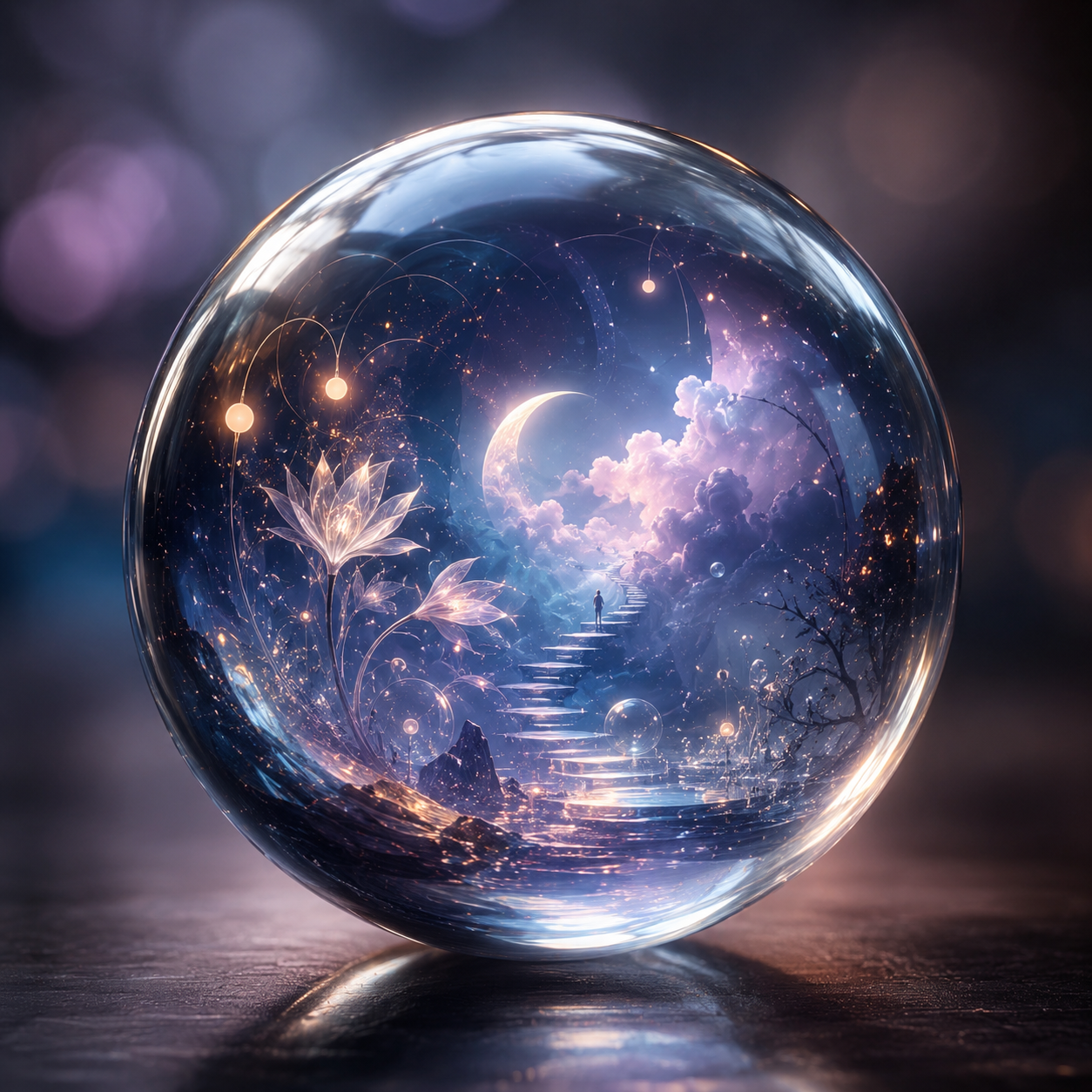
The dream is gathered.
When the dreamer chooses to send a piece to the gallery, the video is gently drawn into a small luminous marble, clear glass with the dream inside it, colour and motion still visible through the surface.
The marble travels.
It rolls through a sequence of environments: old wooden channels worn smooth by water, open air over pale sand, dark conduits of burnished metal, fields of shooting stars, the pulse of circuit-board geometry. Which environments, and in what order, is determined by the nature of the dream itself.
It finds its slot.
At the end of the journey, the marble settles into the gallery beside other marbles that share its character. The dreamer is then brought to the gallery face and sees their dream from the outside for the first time, as a work among works.
The Spaces
Four rooms inside the garden
Your Garden
The dreamer’s private archive. A timeline of one’s own nights, indexed by mood, season, and the symbols a dreamer cannot stop returning to. Held only by the dreamer, learned over years, never pooled and never sold.
The Public Gallery
A living archive of dreams from across the world, anonymous and beautiful. No names, no titles, no algorithms. Works arrange themselves by emotional and symbolic affinity. The dreamer who enters wanders, the way one wanders a museum at dusk.
The Room of Returns
A smaller, dimmer space within the gallery for the dreams that come back: the same staircase, the same house, the same conversation that never quite finishes. Works inside pulse very gently, marking them as things that have come back.
The Grief Garden
A separate, slower environment for the dreams that touch loss. The dreamer plants a flower seeded from the emotional signature of the dream and is permitted to sit with it. Other flowers bloom and fade nearby, planted by dreamers no one will ever meet.
The Dream Globe
A map of what the world is dreaming about
The Dream Globe is a living, interactive world map that visualises dream activity in real time. Colour blooms and moves in clusters corresponding to geographic concentrations of dream content, with hues drawn from the dominant emotional and symbolic signatures of the dreams in that region at that moment.
A region in the middle of a weather event might pulse in greys and silvers. A city in collective grief might cool to deep blue. A festival, a victory, a cultural high might warm to gold. These patterns emerge from what people actually dreamed: not what they posted, not what they consumed, but what surfaced in their sleep.
Click into a cluster and the globe reveals what’s recurring there: the symbols, the iconography, the small selection of anonymised pieces from that region. Over time, the globe becomes a record of how the world dreamed through its history.
The Daily Corridor
No two entries are the same way in
Every day, the path into the Dream Gallery is different. The dreamer does not enter through a static lobby or a menu screen. They enter through a corridor, generated fresh each time, shaped by the intersection of their own recent dream history, the current emotional weather of the gallery, and the time, season, and quality of light in their part of the world.
It might be a long passage of dark stone lit by bioluminescent growth. A forest path at the edge of evening. A tunnel of light dissolving into colour. A cloistered walkway open to a sky that shifts as they walk through it.
The entry sequence is short, never more than thirty seconds, but functions as a transition ritual. The gallery is not a destination you navigate to. It is a space you enter. The quality of attention you bring to it is shaped by how you arrive.
What comes after
The garden’s second act
- The Annual Dream PortraitA single composite film of a dreamer’s year, synthesised from the emotional and symbolic texture of every dream they recorded, offered on the anniversary of their arrival.
- The Annual RoomA curated room within the gallery, opened once a year, holding the Portraits dreamers have chosen to send forward. A document of what this particular year felt like to dream through.
- The Curator’s LetterA short essay accompanying the Annual Room, written each year by an invited guest curator: an artist, writer, psychologist, or cultural thinker who has spent a season with the archive.
- The ResonantsThe anonymous discovery, never explained or notified, that another dreamer somewhere has been returning to the same images as you. A glow at the edge of the gallery, nothing more.
- The VaultA private, deeper personal archive for the dreams a dreamer wishes to keep but not see again. Held, not displayed.
- Guest Curator RetrospectivesMajor, named engagements with the archive at the decade scale. A serious institution treats its own record seriously.
In the larger tradition
An old art, in a new form
National galleries hold centuries of painted and sculpted human experience. They serve as the place where a culture meets its own image. The Dream Gallery belongs to that tradition. It holds the same material in a different register, not as literal depiction but as symbolic, emotional, and where appropriate, figurative translation. The output is no less true for the calibration. It may, in fact, be more true.
Where a gallery in marble walls and gilt frames holds the daylight imagination of its civilisation, Midnight Garden holds the night imagination: translated, anonymised, gathered. It treats dreams as the most democratic creative act in existence and the most thoroughly ignored, and proposes that an archive of them, at scale, becomes one of the more interesting cultural documents of the twenty-first century.
The platform is not a wellness tool. It is not a social network. It is a cultural institution in the form of an application, and it asks to be read against that lineage rather than against its peers in the app stores.
hannah@midnightgarden.art · midnightgarden.art · A project in development